K-Pop Shifts Revenue Focus from Album Sales to Live Concerts...SEVENTEEN Ranks Third on Billboard Chart
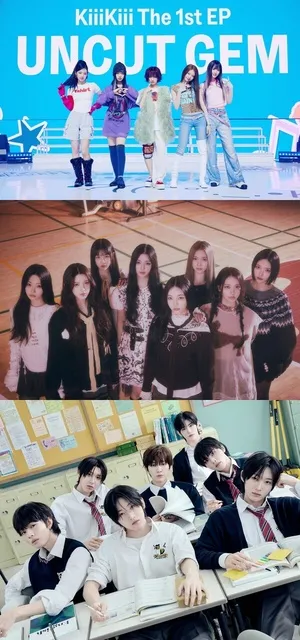
The revenue structure of the K-Pop industry is undergoing rapid changes. There is a clear shift away from generating income primarily through album sales toward earnings from live performances, a trend attributed to strategic adjustments by major agencies in the industry. According to Billboard’s ranking of tour revenues for the first half of 2025 (October 2024 to March 2025), SEVENTEEN achieved third place across all genres, earning $120.9 million and selling 842,000 tickets. This performance placed them behind Coldplay, which generated $142.1 million, and Shakira, who earned $130 million. SEVENTEEN thus set the highest record among Korean artists on Billboard’s tour rankings, surpassing BTS’s fourth-place finish from 2022. The growth momentum in the K-Pop tour market is evident. During the same period, five K-Pop groups—ATEEZ with $28.4 million, j-hope of BTS at $28.1 million, ENHYPEN at $25.6 million, and Tomorrow X Together at $25.1 million—made it into the top 50 of Billboard’s tour rankings. This represents an increase from three groups in 2023 and two in 2022, highlighting the strength of the K-Pop tour market. The total tour revenues generated by K-Pop groups during this period amounted to $228 million, coming from 78 concerts that sold 16 million tickets. Notably, this figure represents a 79% increase compared to the same period in 2024, indicating explosive growth in the K-Pop tour market over the past two years. Major agencies such as SM Entertainment, HYBE, and YG Entertainment all reported rising sales in the first quarter, driven largely by concert revenues. The reason behind these agencies reducing their reliance on album sales and focusing more on tour earnings lies in changing market conditions. With substantial financial resources, these agencies now pursue strategies that allow them to manage multiple groups simultaneously while ensuring continuous activity throughout the year. Recently, K-Pop agencies have significantly shortened the debut cycles of new groups. SM reduced the usual 3.5-year interval to launching two groups per year, while JYP introduced ILLIT this year and plans a multinational boy group project for the second half of the year. HYBE is also rapidly developing groups such as TWS from its label Pledis—launched after nine years—and KATSEYE and ILLIT. Such strategies stem from the market reality that it becomes increasingly difficult for individual groups to sustain a fandom of a certain size. This structural change in K-Pop reflects the evolving status of Korean music in the global concert industry. SEVENTEEN more than doubled its revenues from $30 million in 2023 to $67.5 million in 2024, and with another nearly doubling to $120.9 million in the first half of this year, it underscores the expansion of their global tours. Industry experts predict that this trend will continue. Amid challenges posed by declining album sales, live performances have become a new driving force for K-Pop’s growth.
발행·편집 책임: 국기봉 · KPOP Signal editorialThis article was written with AI from verified source material and passed automated checks before publication. It may contain factual errors. AI disclosure · Request a correction
Comments (0)
No comments yet — be the first to start the conversation.