K-Pop Market Growth Slows Down... Album Exports Increase by Only 0.55%, With Physical Sales Falling Below 100 Million Units
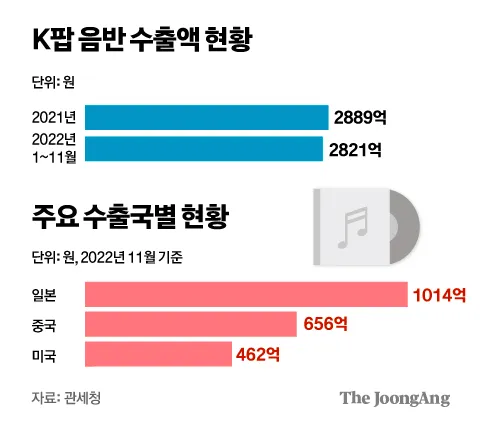
After years of rapid expansion following the COVID-19 pandemic, the K-Pop market experienced a slowdown last year as physical album sales declined and export figures stagnated. According to customs import and export trade statistics, album exports (HS code 8523.49.1040) in 2024 amounted to $291,837,000 (approximately 423.8 billion won), representing a mere 0.55% increase from $290,231,000 (approximately 421.5 billion won) in the previous year. This indicates virtually no growth. Album exports had surged since 2020, the start of the pandemic, reaching $74,594,000 (approximately 108.3 billion won) in 2019, $136,201,000 (approximately 197.7 billion won) in 2020, $220,850,000 (approximately 320.5 billion won) in 2021, and $231,389,000 (approximately 335.8 billion won) in 2022, but this growth momentum was halted last year. Looking at export destinations for 2024, Japan topped the list with $89,786,000 (approximately 130.3 billion won), followed by the United States ($60,293,000, approximately 87.5 billion won) and China ($59,789,000, approximately 86.8 billion won), which together accounted for 72.8% of total exports. Regionally, China showed a strong recovery with a 76.4% increase compared to the previous year, while Japan experienced a 24.7% decline, creating a contrast. A senior researcher at Circle Chart explained, “Until April last year, K-Pop album sales in China fluctuated irregularly, but the local market picked up slightly starting in May. The reason why export data remained stable rather than declining is largely due to the impact from China.” Annual total album sales, which reflect overall market trends, also turned downward. From January to December 2024, according to Circle Chart, physical album sales (combined rankings 1–400) totaled approximately 98.9 million units, a decrease of 21.3 million units from the previous year and falling below 100 million units. The music industry attributes this decline to a reduction in excessive marketing practices. Practices once considered problems in the K-Pop market, such as “first-week sales competition,” “endless fan meetings” (continuing fan signings until all album copies are sold), and “overproduction” (shipping more albums than needed or forcing middlemen to purchase excess stock), have eased somewhat. Additionally, there was no intense competition over sales volumes among major idol group fandoms as seen in 2022–2023. The senior researcher at Circle Chart analyzed, “Last year’s decline in album sales was concentrated among top boy groups, while girl groups performed relatively well with little change compared to the previous year. Therefore, it does not seem to be a structural or fundamental issue within the K-Pop industry that warrants concern.” Last year, the 2024 Paris Olympics, a major sports event, took place in the summer, temporarily reducing interest in K-Pop. As a result, the operating profits of major agencies such as HYBE and SM both declined compared to the same period the previous year, while YG recorded an operating loss and shifted to a deficit. However, the situation is expected to improve this year. BTS members Jin and J-Hope have already completed their military service, and the five remaining members—RM, V, Jimin, Jung Kook, and SUGA—are set to finish their service in June. BLACKPINK is scheduled to begin working on new songs this spring and is expected to launch a new world tour starting in the summer, during the peak performance season. An official from a major agency predicted, “This year will be a year with a strong lineup as BTS and BLACKPINK return, along with third- and fourth-generation idols and their successors active simultaneously.” It is also noteworthy that major agencies such as HYBE, SM, and JYP will introduce new groups one after another this year. JYP will debut the new boy group KickFlip on the 20th of this month, while SM will launch the eight-member girl group Hearts2Hearts and the Korean-English joint boy group Dear Alice next month. These groups are successors to current fourth-generation idols like aespa, IVE, and LE SSERAFIM, and attention is focused on whether they will carry forward the momentum of the K-Pop market.
발행·편집 책임: 국기봉 · KPOP Signal editorialThis article was written with AI from verified source material and passed automated checks before publication. It may contain factual errors. AI disclosure · Request a correction
Comments (0)
No comments yet — be the first to start the conversation.