President Lee Jae-myeong: Government Should Support K-Pop Without Interference...Presenting Vision for a Cultural Powerhouse
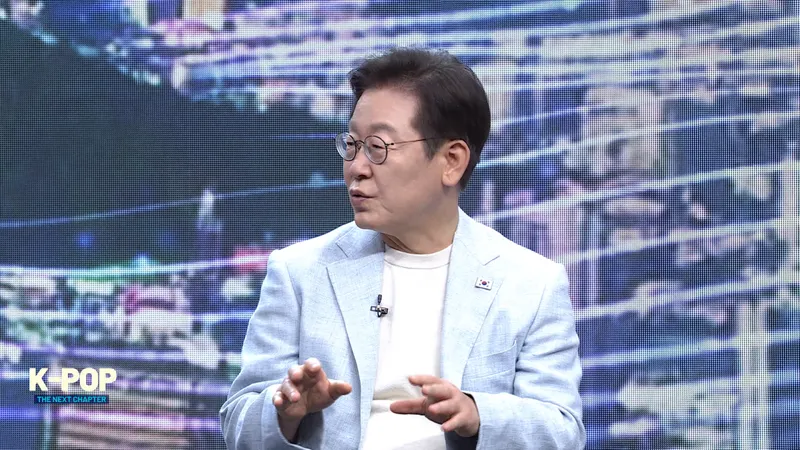
President Lee Jae-myeong expressed strong determination regarding the future of South Korea’s cultural industry and the government’s role in it. On August 20, appearing on Arirang International Broadcasting’s program “K-Pop: The Next Chapter,” he stated that “the opportunity to truly showcase the power of Korean culture is now fully underway” and added that “South Korea has entered the early stages of becoming a cultural powerhouse.” He linked K-Pop’s fundamental strength to democracy. “Political resistance usually manifests as violent acts of burning and destruction, but in Korea, people fight with lightsticks through music and dance,” he said. “It may seem strange from an external perspective, but ultimately this approach is beautiful and becomes a source of strength to overcome challenges.” He further noted that “ancient Chinese texts also record that the people of the Korean Peninsula are skilled in singing and dancing,” emphasizing that “Korea is a nation that has overcome difficulties through humor and art.” He identified redefining the government’s role as a key task. “Just as a giant tree needs well-maintained grasslands, pure art and various cultural fields require a solid foundation,” he explained. “The field of pure art falls under the responsibility of the government, not the market.” In particular, he pointed out that “political powers have an instinct to control, manipulate, and exploit art” and criticized the fact that “the principle established by former President Kim Dae-jung—‘supporting without interfering’—has not been properly upheld.” He mentioned blacklists as a specific example of cultural control. “The government’s role is to create a free environment rather than surveillance and regulation,” he stressed. “Repeating restrictions and selections like blacklists kills creativity. The government must create a free environment so that artists can grow through competition.” He highlighted the expansion of large-scale concert venues as an essential requirement for building an industrial foundation. “There are many large-scale concert venues abroad, but Korea still lacks them,” he said, adding that “as a governor, I tried to promote arena construction but faced difficulties.” He further emphasized the need to improve regulations so that existing facilities can be adapted for use if large-scale venues are unavailable. He repeatedly stressed the importance of equal opportunities and creating a favorable environment. “Opportunities should be evenly distributed in the cultural and artistic fields so that everyone can pursue them, but this area has been largely neglected,” he said. “It is truly remarkable and almost miraculous that such great works and artists have emerged.” He added, “We must invest heavily and provide support for the cultural ecosystem so that more people can take part. We can expect great things—groups like TWICE and MEGGI GANG 2, 3, 4 should emerge.” He proposed expanding beyond K-Pop to include other cultural industries. “As K-Pop, dramas, and movies became known worldwide, Korean language learning has spread globally,” he said. “This trend can extend to industries such as food (K-food) and beauty (K-beauty).” He stated, “The cultural industry does not require many raw materials or resources. Video, animation, music, and dramas have great potential, and food and beauty industries can also grow significantly in the global market.” He declared his intention to make cultural content a core national industry. In particular, he emphasized K-Pop’s global scalability by saying, “The most Korean things are the most global.” Referring to an impressive scene from KPop Demon Hunters, he mentioned that “the soupy noodle stew and kimchi were the best,” and cited the tiger “Theppy” and the underworld messenger as standout characters. “It was impressive how the scary tiger was turned into something cute and humorous. It is important to showcase everything that is unique to us.” He provided a macro-level assessment of the future value of culture. “South Korea does not have abundant resources, but it is a country where people are the resources,” he said. “No other country has achieved industrialization and democratization simultaneously in such a short time. That is why the world views South Korea as a fascinating Eastern nation.” He added, “In the future, there will be limits to material prosperity. The next step will be to meet cultural needs, which becomes an important future challenge.” He concluded by saying, “If we show interest and pride, we can become a proud cultural powerhouse. The government will create more opportunities for our citizens.”
발행·편집 책임: 국기봉 · KPOP Signal editorialThis article was written with AI from verified source material and passed automated checks before publication. It may contain factual errors. AI disclosure · Request a correction
Comments (0)
No comments yet — be the first to start the conversation.