K-pop’s Dominance Spreads Across Global Sectors – Billboard, NBA, and Beauty Industries Included
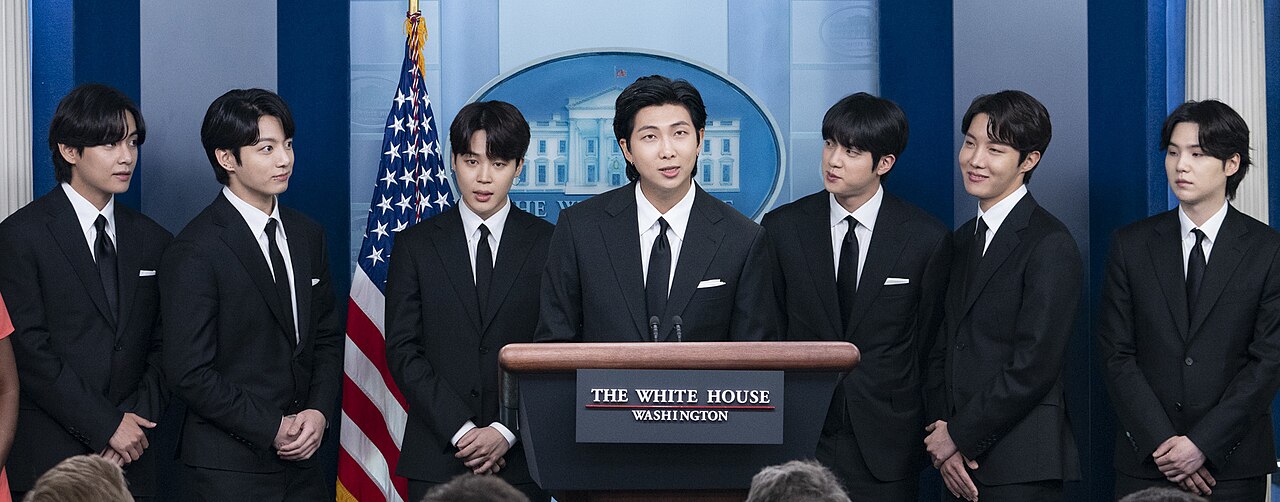
Photo The White House / Public domain — Wikimedia Commons
K-pop is expanding its influence beyond the music industry to affect global economies, sports, and beauty markets as well. The “2026 Billboard Power 100” list released by Billboard in the United States features a record five Korean K-pop industry figures, underscoring the genre’s global standing.
In Billboard Power 100’s “multisector” category—encompassing all aspects of the music industry such as planning, production, distribution, and investment—HYBE’s Bang Si-hyuk (founder and chairman), Lee Jae-sang (CEO), and Isaac Lee (CEO of HYBE America) ranked fifth. JYP Entertainment’s Park Jin-young (founder and chief creative officer), Jung Wook (CEO), and Shin Hyun-guk (CEO of JYP America and chief strategy officer) placed 12th. Billboard analyzed that JYP Entertainment achieved a record revenue of $157 million in the second quarter of 2025, capitalizing on K-pop’s worldwide popularity, with concert and merchandise revenues rising by 342% and 356% respectively marking the peak performance of that quarter.
K-pop stars are also becoming increasingly active in NBA global marketing campaigns. BTS’s SUGA was appointed as an NBA Global Ambassador in April 2023, and his encounter with Stephen Curry during the 2022 NBA Japan Game generated over 40 million social media impressions. BLACKPINK’s Rosé attended a New York Knicks preseason game at Madison Square Garden in 2024, while (G)I-DLE’s Yuki appeared at the 2025 February NBA All-Star Game in San Francisco, where she met NBA legends Yao Ming, Tracy McGrady, and Jason Tatum. LE SSERAFIM attended a Los Angeles Lakers home game in November 2023, and HYBE’s rookie group CORTIS is set to make history as K-pop’s first headliner for the NBA CrossOVER concert series’ All-Star Weekend on February 12, 2026.
Korea’s influence is also growing significantly in the K-beauty market. Last year, South Korea’s cosmetics exports reached a record high of $11.43 billion, with the largest export destination shifting from China to the United States. Exports to the U.S. amounted to $2.186 billion, a 15.1% increase from the previous year and accounting for 19.1% of total cosmetics exports. In contrast, exports to China declined by 19.2% to $2.014 billion, while Japan remained in third place with $1.087 billion in exports.
By product category, basic cosmetics accounted for $8.54 billion, representing 74.7% of total exports. However, colored cosmetics saw a 12% increase, and personal care products experienced a 27.3% rise. Perfumes posted the highest growth rate at 46.2%. The number of export destinations expanded by 30 countries to 202 nations, with significant increases in exports to Europe, the Middle East, and Latin America. Exports to France rose by 73.6%, while those to the UK increased by 54.7%. The UAE and Poland entered the top 10 export destinations respectively, with increases of 69.7% and 111.7%.
Meanwhile, CJ Olive Young, a major domestic beauty retailer, has established a strategic partnership with Sephora and plans to expand K-beauty sections curated by Olive Young across both offline and online channels starting in the first half of 2026.
발행·편집 책임: 국기봉 · KPOP Signal editorialThis article was written with AI from verified source material and passed automated checks before publication. It may contain factual errors. AI disclosure · Request a correction
Comments (0)
No comments yet — be the first to start the conversation.