K-POP Expands Beyond Music into Education, Finance, Retail, and Fashion as Global Cultural Ecosystem Grows
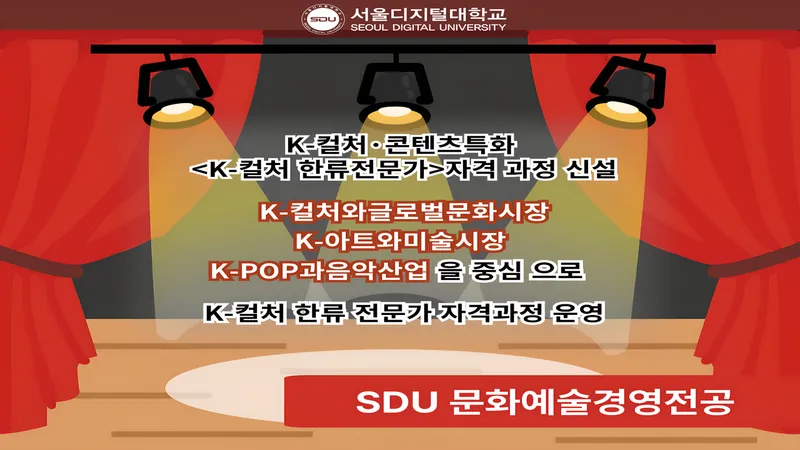
K-POP is expanding beyond the music industry into a wide range of sectors including education, finance, retail, and fashion, thereby fostering the establishment of a full-fledged global Hallyu ecosystem. **K-Culture Spreading into the Education Market** The Department of Cultural and Art Management at Seoul Digital University introduced a certification program for “K-Culture Hallyu Experts” starting in the 2026 academic year. The program aims to train professionals with specialized skills in Korean cultural and artistic fields such as K-content, K-art, and K-POP. Courses include “K-Culture and Global Cultural Markets,” “K-Art and Art Markets,” and “K-POP and the Music Industry,” offering practical training applicable directly in the cultural industry. Graduates of this program receive a certificate issued on behalf of the university, and it is expected to contribute to the development of experts in Hallyu content marketing and the entertainment industry. Howon University is also leading Hallyu culture education through the establishment of a K-POP major. This major was the first in the university to launch girl groups like “Azel,” boy groups like “Chaos,” and mixed groups like “Zephyr,” providing a practical foundation for their debut. Along with the Department of Performing Media and the Department of Practical Music, Howon University drives domestic education in new Hallyu culture and art. **Integration of Fan Platforms and Finance** A new collaboration model has emerged as the global K-POP fan platform “KpopStarpic” combines with the financial industry. With over 3 million cumulative downloads and users in 180 countries worldwide, KpopStarpic signed a business agreement with Soso Bank. By integrating participatory services such as birthday events, popularity polls, and fan content creation with global financial infrastructure, it aims to create a new fan culture ecosystem. KpopStarpic is showing rapid growth, with expectations that its cumulative downloads will exceed 10 million by next year. **K-Retail Proving Its Global Growth Model in Vietnam** Korean retail companies are testing their global K-retail business models through the Vietnamese market. GS25 expanded from 26 stores in 2018 to 394 stores by 2025, a more than 15-fold increase, while its sales grew by approximately 37 times. Utilizing Korean foods such as tteokbokki, pork fried rice rolls, and buldak ramen, it has become a dominant force in Vietnam’s convenience store market. GS25 is pursuing a strategy of providing “cultural experiences” through hybrid stores that combine pharmacies and convenience stores. The Lotte Group is dominating the Vietnamese market with its premium retail spaces. Lotte Mall West Lake Hanoi, opened in 2024, surpassed 57 billion won in cumulative sales by August this year. It offered an “experience-based shopping” model through sections dedicated to Korean cuisine like “K-Flavor” and pop-up events, while Lotte Mart differentiated itself with “K-food specialty zones” and “Korean fruit specialty zones.” **The Grannicore Fashion Trend Driven by K-POP Idols** “Grannicore,” which modernizes fashion for the senior generation, is spreading as a global trend. In particular, K-POP idols have played a key role in popularizing “kimjang jackets.” When BLACKPINK’s Jennie and aespa’s Karina shared photos wearing kimjang jackets, it caught the attention of Gen Z fans, causing search volumes to increase by more than 5 times, rising from 18 to 100 searches at the beginning of this month. These jackets ranked within the top 10 on online shopping platforms and received over 290 reviews. Their affordability, around 5,000 won, combined with a cozy silhouette and an appeal that evokes floral patterns, contributed to their popularity. This trend has also spread to foreign tourists, with Japanese visitors coming to Korea to purchase them in large quantities. One Hallyu critic described it as the “grandma jacket” and evaluated it as an expansion of global fashion trends through K-pop. In this way, the K-POP industry is evolving into a true global cultural industry by expanding into various fields such as music, education, finance, retail, and fashion. With K-retail and K-fashion gaining traction in Asian markets like Vietnam and Japan, and university-level training for experts underway, the construction of a sustainable Hallyu ecosystem is accelerating.
발행·편집 책임: 국기봉 · KPOP Signal editorialThis article was written with AI from verified source material and passed automated checks before publication. It may contain factual errors. AI disclosure · Request a correction
Comments (0)
No comments yet — be the first to start the conversation.