"Idols Who Understand Music Create the Best Songs" – Composer Kim Soo-bin on the Path to K-POP Creation
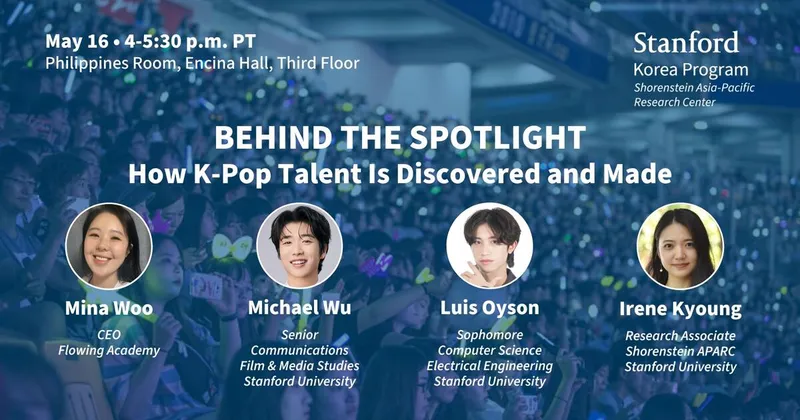
Testimonies from key figures detailing how K-POP’s talent discovery and creation processes have evolved are attracting significant attention. On May 16, the Stanford University Foreign Service Institute (FSI) held a panel discussion titled "Behind the Spotlight: How K-Pop Talent Is Discovered and Made." Current K-POP trainees, Stanford students, and industry insiders participated, revealing behind-the-scenes insights into talent recruitment and discovery. Michael Wu, a third-year student at Stanford, is a dancer born in Poland and raised in Canada. He has five years of experience in ballet and contemporary dance, along with 11 years of competing in hip-hop. After reaching the semifinals of NBC’s "World of Dance," the finals of "Canada's Got Talent 2021," and winning a silver medal at the Hip-Hop International Dance Championship, he was recruited as a trainee for Starlight Boys. Selected through a video interview in a campus study room, he was sent to Korea, describing his journey as one shaped by "passion, patience, and unexpected opportunities."
There is also someone who has personally experienced changes in the K-POP composition system. Kim Soo-bin, who debuted in 2013 as a member of the boy band Say Yes and is currently 38 years old, began composing in 2008 and has written over 400 songs in K-POP, J-POP, and C-POP genres. His works include Super Junior’s "Super," Exo-CBX’s "Gentleman," and Twice’s latest song "Dive." His experience as an idol has had a profound impact on his composition skills. "I learned how singers manage their vocal cords, how to sing while dancing, and how pronunciation changes depending on mouth shape," Kim Soo-bin said. "Before becoming an idol, I faced many difficulties when writing songs for others. But now I know which melody suits which voice and what makes it easy to sing on stage. This is the key difference between a title track and a B-side song." He emphasizes that understanding idols as individuals is also crucial. "Many composers don’t even know the members’ names. But I have thoroughly studied other groups. If another idol does something amazing on stage or has a unique singing style, I remember it. These insights help me with vocal directing, allowing me to find ways for artists to feel comfortable while bringing out their best performance."
K-POP’s composition culture has changed rapidly over the past 15 years. "In the early 2010s, Korean producers mostly worked alone. Although guide vocals were sometimes used, collaboration was not part of the culture. Things started to change in the mid-2010s, with an increase in international collaborations," Kim Soo-bin recalled. This reflects the expansion of the global market and the internationalization of K-POP. The fact that Kim Soo-bin, who was 27 when he debuted in 2013, signed a "five-year contract instead of the typical seven years" also illustrates the age bias in this industry. "Most idols debut in their teens or early 20s, and I was considered too old for that," he explained.
발행·편집 책임: 국기봉 · KPOP Signal editorialThis article was written with AI from verified source material and passed automated checks before publication. It may contain factual errors. AI disclosure · Request a correction
Comments (0)
No comments yet — be the first to start the conversation.