Global Background K-pop Idols Emerge One After Another... A New Shift in the Industry’s Pursuit of Diversity
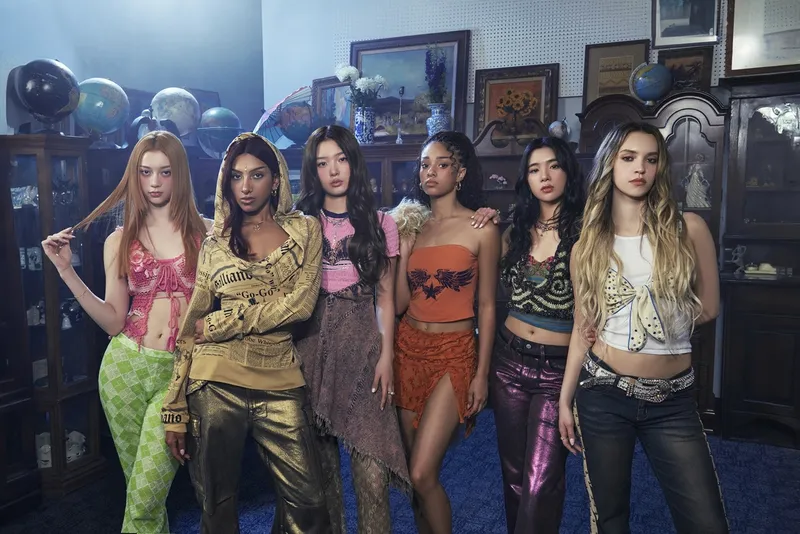
The K-pop industry is becoming increasingly diversified. From HYBE’s multinational girl group to rookie groups composed of North Korean defectors and boy groups trained in K-pop in the UK, idols with diverse backgrounds are entering South Korea’s global music industry and reshaping its landscape. Lara Raz, a member of HYBE’s first multinational girl group Cathay, publicly discussed her sexual orientation on the fan community platform “Weverse” on the 28th. The 19-year-old Indian-American singer revealed that she realized she was “bisexual” at around age 8 and reinterpreted derogatory terms used against the LGBTQ+ community. She also said she was deeply worried about how her sexual identity might affect her chances of making her debut during her time in “The Debut: Dream Academy.” Lara’s coming out marks the first time an artist under a major agency has publicly disclosed such information in K-pop history. Music critic Im Hee-yoon described it as “a shocking and groundbreaking event in an industry culture that has maintained conservative standards despite K-pop’s creative diversity.” HYBE stated that this was an individual matter for the artist. North Korean defectors are also beginning to appear on K-pop stages. Hyuk, a member of the rookie boy group 1Verse, confessed that he skipped school and worked on the streets in North Korea’s Hamgyong Province to survive, saying he “had to steal quite a lot just to get by.” He came to South Korea in his early teens at the urging of his mother, who had escaped to the South. Recalling that time, he said, “That world was nothing but North Korea—nothing more.” Seok, another member of the same group, grew up in North Korea but in a relatively wealthy family near the border, allowing him to illegally listen to K-pop through smuggled materials. He escaped to the South at 19 and said, “I wanted to imitate those amazing expressions and styles,” and now he has become an idol himself. Michelle Cho, CEO of the small-label Singing Beetle, said that as soon as she heard Hyuk’s strong rapping talent, she knew “it was a natural gift.” The British-born K-pop training boy group Dear Alice is also gaining attention. The five-member group, consisting of Blaise Noon, Dexter Greenwood, Ollie Quinn, James Sharp, and Rhys Carter, had their 100-day dance and vocal bootcamp in Seoul, South Korea, featured in a BBC documentary titled “Made in Korea: The K-pop Experience.” When they first appeared on screen, they were ordinary British youths wearing loose, neutral-colored clothes. By the end of the six-part series, they had transformed into confident individuals with bleached buzzcuts, curtain bangs, and gravity-defying curly hair. Trained under director Yoon Hee-jun of SM Entertainment, they have formed partnerships with Kakao Entertainment, the American label Gamma, and the British production company Moon & Buck Media. Their emergence comes amid strengthened labor protection measures implemented in 2024 following criticism of exploitative practices in the K-pop industry. Blaise Noon said, “What we do has never been tried before,” adding, “There are no rules to follow, so we have to discover everything on our own.” The globalization of K-pop is no longer a myth. While there have been cases in the past, such as BLACKPINK with non-Korean members, today we are entering an era where idols with entirely global backgrounds are taking center stage in K-pop. From Lara’s coming out to the debuts of North Korean defectors and the transformations of British youths, K-pop is evolving from a South Korean industry into a true global cultural industry.
발행·편집 책임: 국기봉 · KPOP Signal editorialThis article was written with AI from verified source material and passed automated checks before publication. It may contain factual errors. AI disclosure · Request a correction
Comments (0)
No comments yet — be the first to start the conversation.