Fusion of Korean Mythology and K-Pop as Virtual Idols Dominate Real Charts
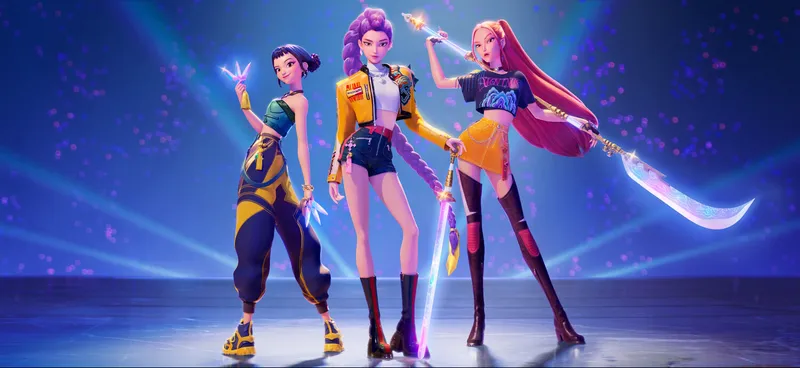
The Netflix original animation “KPop Demon Hunters” topped the movie category in 41 countries worldwide shortly after its release on June 20, demonstrating a new trend within Hallyu culture. By breaking down boundaries between reality and virtuality, music and animation, this work has impacted not only visual content but also the music market itself. Songs by virtual K-Pop groups have achieved results comparable to those of real idols. On June 23, the virtual girl group HUNTR/X from Netflix and Sony Animation became the most streamed girl group on Spotify globally, surpassing popular real girl groups such as TWICE and CATSAY to occupy top positions. Shortly after the movie’s release, HUNTR/X’s song “Golden” reached position 14 on Spotify’s global chart, with 2.78 million streams in a single day. Additionally, all 8 tracks included in the soundtrack entered Spotify’s U.S. chart top 100, with “Your Idol” and “Golden” ranking at positions 6 and 8 respectively as of June 28. The movie depicts the K-Pop girl group HUNTR/X performing passionately on stages during the day and acting as demon hunters to defeat evil spirits at night. This setting, which combines elements from Korean shamanistic beliefs such as dokkaebi, tiger spirits, and jeseungsaja with K-Pop conventions, has exerted a strong appeal that influences both viewers and the music market. According to a statement from their agency, The Present Company, on June 27, another virtual boy group from the movie, Sazaboyz, entered Spotify’s U.S. chart top 10, marking the first time this has happened since BTS. Producers involved in creating the soundtrack include Teddy, who has worked with BIGBANG, BLACKPINK, and TWICE, as well as Grammy-winning producers Lindgren and ZENA ANDREWS. A star-studded cast including actors Lee Byung-hun and Aden Cho also contributed to the voiceovers, and the music created by real K-Pop producers was designed to be immediately recognized as authentic K-Pop in the music market. Producer Teddy worked at the request of director Maggie Kang, and their goal was to ensure that even if the songs were released immediately, people would recognize them as K-Pop. Fan reactions comparable to those for real idols have also been observed. A surge in secondary creative activities such as live streaming, photo cards, and fan interactions has taken place, with active support for HUNTR/X from fans in online communities just like they do for real K-Pop idols. This shows that this work, which breaks down boundaries between reality and virtuality, has succeeded in transforming into something more than just an animation by completing the fan ecosystem. The dedication of the production team is also evident. Director Maggie Kang brought 10 team members to Korea to experience local culture firsthand, walking through areas like Bukchon, Minsookchon, and Myeongdong to capture detailed elements. Everything from the characters’ clothing and food to small details such as tissues under chopsticks was infused with Korean aesthetics. Merchandise inspired by characters like “Theppy,” created based on the traditional Korean painting “Jakhodo” featuring tigers and magpies, is expected to sell out quickly. Meanwhile, controversy arose regarding the copyright of Namsan Seoul Tower. A post posted by the art director on social media claiming that production was made easier due to permission from Namsan Tower’s copyright holders spread online, but Lotte Merchandising stated that they had received no inquiries from the project and had never restricted the use of the image based on copyright issues. Instead, Lotte said they cooperate without restrictions for video shooting or CG usage and do not object to unauthorized use in non-commercial contexts. According to legal experts, buildings like Namsan Tower, which are open 24/7, can generally be reproduced using paintings or photos, but special consideration may be needed if they become the core subject of a work. The success of this project demonstrates how powerful a hybrid structure combining K-Pop and Hollywood can be for global audiences. Netflix previously attempted a similar strategy in 2019 through Miley Cyrus’s virtual icon Ashley OR in an episode of Black Mirror, and “KPop Demon Hunters” represents a further refined version of that approach. This expansion, blending reality and virtuality, music and animation, genres and borders, as well as tradition and modernity, is expected to continue in the future.
발행·편집 책임: 국기봉 · KPOP Signal editorialThis article was written with AI from verified source material and passed automated checks before publication. It may contain factual errors. AI disclosure · Request a correction
Comments (0)
No comments yet — be the first to start the conversation.